
Jun 09, 2026 / By Melissa McClements
11 min read
SHORT TAKE: The Iran war’s oil shock, jet fuel shortages and heightened geopolitical volatility are accelerating favorable conditions for Sustainable Aviation Fuel (SAF) adoption. Price spikes, energy security pressures, military resilience needs, long-term fossil fuel risk premiums and likely regulatory tightening are converging to make SAF a strategic, economic and security imperative.
Whether the U.S.’s war with Iran ends imminently or not, it has exposed a reality the aviation industry has long preferred to ignore: the global aviation fuel supply chain remains dangerously concentrated and vulnerable to geopolitical shocks.
As 20% of seaborne jet fuel passes through the Strait of Hormuz, the blockade has caused soaring oil prices, long-term jet fuel shortages, and surging increases in airfares, among many other price hikes. With the risks of relying on a single global fuel ecosystem now impossible to ignore, does this mark a turning point in the industry’s adoption of Sustainable Aviation Fuels (SAFs)?
Here are five reasons why this conflict could mark the start of SAF's next phase of take-off, driven as much by energy security and resilience as sustainability.
#1. Airlines are being financially hit with the fallout from geopolitical tensions
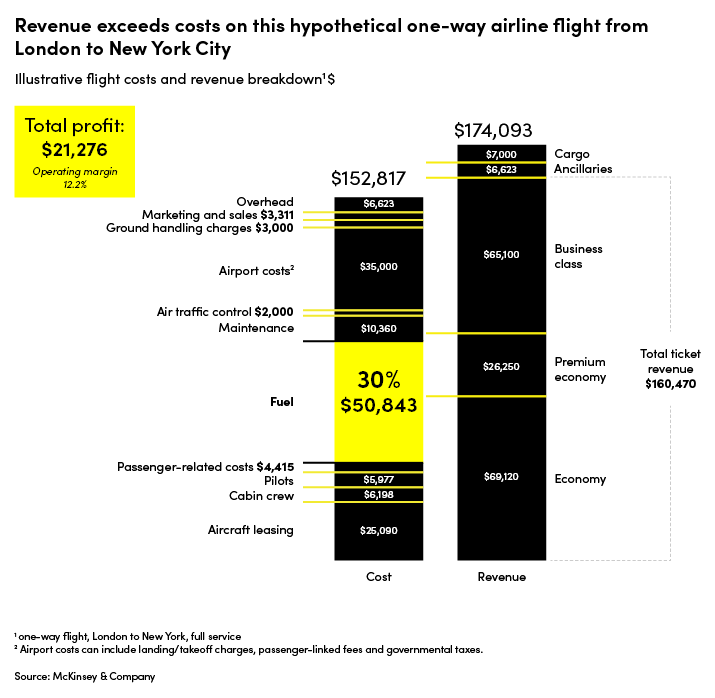
Fuel typically accounts for between 25% and 30% of an airline’s operating costs (some estimates are higher), so the doubling of conventional jet fuel prices is hitting airlines and travelers hard. Coupled with a shortage, the situation is unlikely to change soon. Even if the conflict ends tomorrow, supply chains won’t immediately recover. Industry observers have warned that it could take months for fuel flows to return to pre-crisis levels.
This means the long-term costs and unpredictability of fossil fuel dependence are becoming harder to absorb and plan for operationally. Globally, economic pressures on the sector have led to the elimination of 2 million airline seats. Higher costs even tipped the U.S. ultra-low-cost carrier Spirit over the edge, which blamed fuel cost increases for its bankruptcy.
This, however, doesn’t mean that SAFs are suddenly financially viable. While they were around three times as expensive as their fossil-fuel counterparts before the war, the cost difference has narrowed only slightly. As the majority of current SAFs are produced from feedstocks such as waste oils, animal fats and agricultural residues, their prices have edged up due to the knock-on effects of the oil crisis on their supply chains.
The self-imposed conflict has made clear that aviation's fuel challenge is not simply about emissions control. It’s also about resilience. Airlines have proven time and again they can manage demand fluctuations, competitive pressures and even economic downturns. But they can’t control geopolitical flashpoints that double fuel costs almost overnight.
SAF Investment Is Accelerating
In May 2026, Acelen Renewables secured $1.5 billion in financing for a new biorefinery in Bahia, Brazil, expected to produce 1 billion liters of SAF and renewable diesel annually starting in 2029. Backed by Mubadala Capital and a consortium of international financial institutions, the project demonstrates that large-scale SAF production is attracting serious long-term capital despite ongoing market uncertainty. The facility is expected to integrate agricultural production, industrial development and advanced fuel technologies, with approximately 90% of planned SAF and renewable diesel volumes already structured and contracted.
THE SIGNAL: Capital is flowing into SAF production at a scale unimaginable just a few years ago.
#2. Fuel security has become an operational priority
The industry has spent decades optimizing aircraft, routes and operations. Fuel supply remains one of the few critical variables largely outside its control.
As Europe is set to cross a critical threshold this month that could trigger many more flight cancellations and the closure of smaller airports, just in time for the continent’s busiest travel period, the need for secure jet fuel supplies has never been clearer. SAFs offer a domestic, locally producible alternative that reduces reliance on conflict-affected foreign oil.
Indeed, the aviation sector is starting to recognize fossil fuel dependency as a resilience and security issue, not just a sustainability problem. SAFs offer a means of using domestic waste or agricultural feedstocks, turning fuel from a volatile global commodity to a local, more stable one.
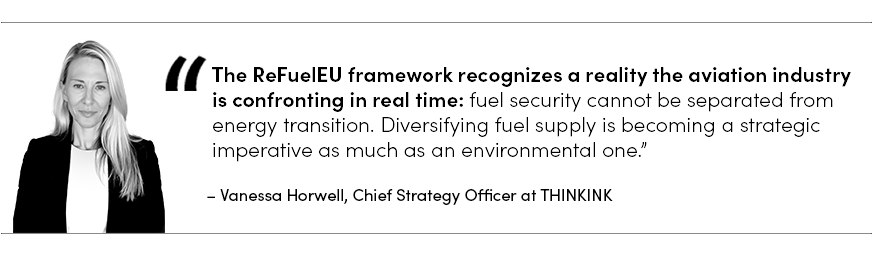
The European Union's ReFuelEU Aviation framework provides perhaps the clearest example of how governments are approaching the challenge. The regulation is designed to increase both the supply and uptake of SAF across Europe through progressively higher blending mandates, while stimulating investment in domestic production capacity and reducing dependence on conventional jet fuel.
#3. Military planners are reaching the same conclusion
It’s not only airlines that are viewing the scaling of localized SAF production as a means of strengthening resilience. Military leaders increasingly see it as critical to national security, ensuring that military flights can continue regardless of the situation in the Middle East.
Several European militaries have already been trialing green jet fuels. The French Air and Space Force has begun testing a fuel blend that uses 30% SAF combined with fossil fuel, as part of the national military Climate and Defense strategy. The Royal Netherlands Air and Space Force is committed to ensuring that 30% of its fuel comes from biofuels by 2030. Meanwhile, Sweden’s military has been testing biofuels in some of the engines used in its fighter jets. Finally, even though the UK has controversially just relaxed its sanctions on jet fuels derived from Russian crude oil, the British Royal Air Force is still bound to increase its use of green fuels under the national government’s SAF mandate. In the present geopolitical context, such pushes for energy sovereignty must surely only increase.
#4. SAF is becoming a hedge against geopolitical risk
Airlines have spent decades hedging against fuel price risk. Now, they may need to hedge fuel systems.
At present, the degree of an airline’s exposure to international oil market fluctuations largely depends on its fuel hedging policy, an industry strategy that enables carriers to lock in future fuel prices and protect themselves from sudden market swings. Through contracts agreed with suppliers or financial institutions, they can fix the price they will pay for their fuel over a set period.
Accordingly, some airlines have ridden out the oil crisis so far because they’d locked in their fuel costs beforehand. These include Air France-KLM, EasyJet, IAG, Ryanair, Air New Zealand, Qantas, Singapore Airlines and Icelandair. But even for these airlines, if prices are higher for longer, the impact will eventually show somewhere–in fares, which routes are flown or the number of canceled flights. Moreover, low-cost carriers typically do not hedge fuel costs due to their lean business models and quick turnaround time.
As a result, the current crisis has introduced a long-term ‘risk premium’ on fossil fuel prices, prompting airlines to view SAFs as a way to hedge against future oil market fluctuations. A greater supply of SAFs could enable airlines to lower their dependence on fossil jet fuel, with a corresponding reduction in hedging needs.
Japan's Airlines Issue a Warning on Fuel Security
In May 2026 JAL and ANA released a joint report warning that SAF accounted for just 0.6% of global aviation fuel consumption in 2025 and that production must increase significantly within the next five years if aviation is to meet its decarbonization targets. The report also linked fuel supply directly to national resilience. ANA President and CEO Juichi Hirasawa warned that "any delay in securing fuel now represents a direct crisis for Japan's economic security." The airlines called for a coordinated effort involving government, industry and customers to support SAF adoption and secure long-term fuel supplies.
#5. Governments will come under pressure to strengthen SAF policy
Most government responses to the current oil crisis have focused on immediate relief measures, including fuel tax cuts, rationing and emergency energy interventions. While these may help manage short-term disruption, they do little to address the underlying issue: aviation's dependence on fuel supply chains vulnerable to geopolitical shocks.
The current crisis has strengthened the case for policies that expand SAF production and diversify fuel supply. That does not mean new mandates will appear overnight. But energy crises have a history of accelerating investment, reshaping policy priorities and changing how governments think about long-term resilience.
Expanding SAF production will require significant investment, technological progress and sustained policy support. The alternative is continued exposure to the same supply risks and market volatility now rippling through the aviation sector.
Increasing production from today's technologies will not be enough. Policies must be introduced that direct investment towards startups focused on SAF R&D. The limited availability of biomass feedstocks that most SAFs are made from is a bottleneck to scaling, while eSAFs (synthetic fuels made by combining captured carbon dioxide and green hydrogen) remain prohibitively expensive, require vast amounts of energy and depend on the expansion of both renewable energy and carbon dioxide sourcing, like direct air capture.
Solving for long-term fuel stability and supply chain resilience
The disruption in the Strait of Hormuz has exposed the vulnerability of fossil-fuel supply chains to geopolitical events and reframed SAFs as tools for stability and resilience.
By expanding and decentralizing production, SAF and other green fuels can strengthen energy resilience and regional energy independence and reduce the impact of conflicts that disrupt supply lines and economic exposure to volatile oil markets.
SAF will not solve today's fuel crisis. Production remains constrained, costs remain high and significant technological hurdles remain. But the events unfolding around the Strait of Hormuz are changing the conversation.
The industry has spent years discussing SAF as a climate solution for decarbonization. Today, that narrative has quickly shifted to an energy-security solution as well, bolstering economic resilience and supply chain stability. For an industry that depends heavily on predictability and reliable access to fuel, that may prove to be the most compelling argument yet.
For an industry that depends heavily on predictability and reliable access to fuel, that may prove to be the most compelling argument yet.
Want more climate & sustainability insights? Check out these resources