Jun 17, 2026 / By Melissa McClements
9.5 min read
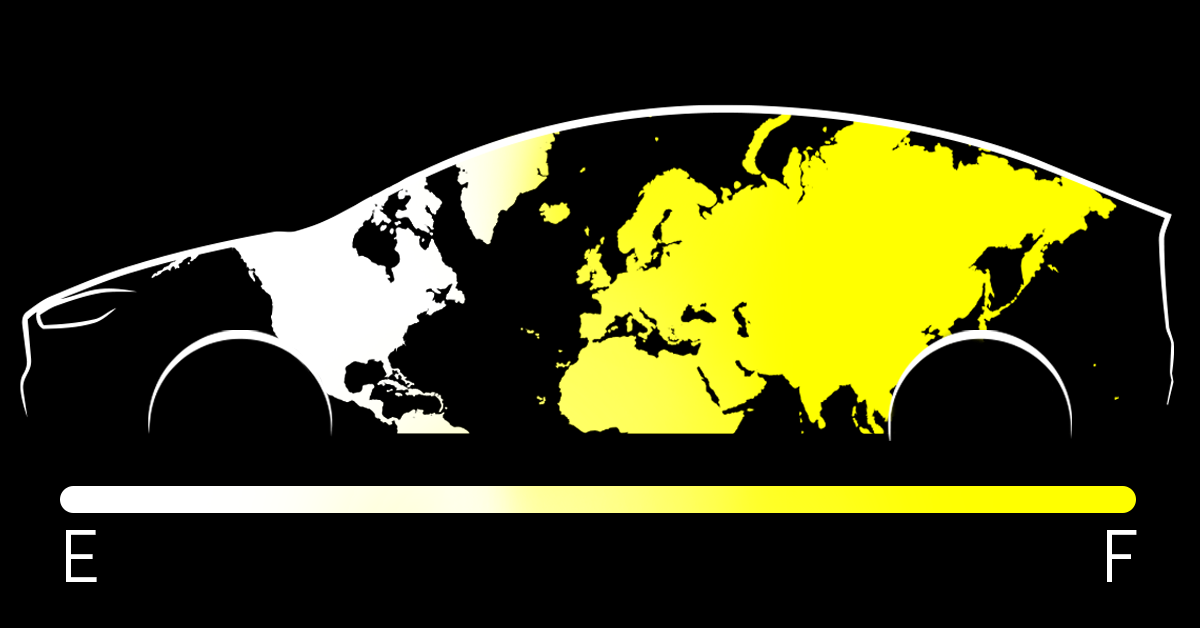
SHORT TAKE: Global EV sales have reached a tipping point, driven by China's manufacturing dominance, Europe's policy support and rapid growth in emerging markets. As electric vehicles go mainstream worldwide, the U.S. risks falling behind, raising questions about its competitiveness, industrial strategy and ability to re-enter the race. A rapid U-turn is needed if America wants to catch up.
While China, Europe and emerging markets push ahead with EV adoption, the U.S. is retreating from the policies that helped build its electric vehicle market. Under the second Trump administration, U.S. federal support for the sector has gone into reverse at full speed.
On the president’s first day in office, he signed the Unleashing American Energy Order, directing government agencies to reassess programs tied to EVs. Trump continued his assault on clean cars by freezing the National Electric Vehicle Infrastructure program and later proposing to relax fuel-efficiency standards for cars. Most recently, the regime has repealed federal limits on vehicle tailpipe emissions, setting back much of the progress made in the U.S. by at least several decades.
Contrast those measures with the actions undertaken by countries surging forward in EV adoption and investment. China has made EV production a focus of state financial and policy support, providing extensive funding to manufacturers and battery suppliers, as well as a grant scheme for consumers buying EVs, though that scheme ended in 2022 due to market maturation.
Europe also presses ahead. The European Union (EU) has backed EV adoption with far greater fiscal support than the U.S. and a regulatory framework to accelerate the transition. A bloc-wide target to cut new car and van emissions by 90% by 2035 is encouraging manufacturers to invest in affordable, locally produced EVs. Although there’s no single EU-wide incentive program for consumers to buy EVs, nearly all member states offer some form of tax benefit or purchase subsidy. That’s all gone for American consumers.
Global EV sales have reached a tipping point… except in the U.S.
Despite the U.S. policy backlash, global EV sales have reached a tipping point that has “triggered an irreversible shift away from their gasoline-powered equivalents,” according to new research from the University of Exeter. Analyzing worldwide sales between 2016 and 2023, the researchers found that sales increased exponentially across 32 countries, while overall sales of petrol and diesel cars have slowed since 2019.
The International Energy Agency (IEA) also found that global EV sales grew by 20% in 2025, exceeding 20 million, meaning that one-quarter of all new cars sold worldwide last year were electric. Coupled with the oil crisis, this growth is likely to continue, with markets outside of the U.S. and China already experiencing a 50% jump in March-April sales.
While the rest of the world accelerates EV adoption, will the U.S. ever regain its position in a market it once helped pioneer?
In a plot twist, China is dominating the EV sector
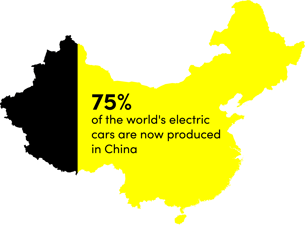 Thanks to strong government backing and control of a critical portion of the global battery supply chain, from raw material processing to cell manufacturing, China is now the world’s top EV manufacturing hub. In 2025, it accounted for nearly 75% of all electric cars produced globally. Considering that the U.S, the world’s second-largest car market, imposes a 100% on all Chinese electric cars and has therefore effectively locked them out, this is quite a feat.
The country’s EV exports also surged 40% in April, most likely due to oil market shocks. But it’s not only about overseas sales. The country recently reached over 50% EV sales share for the first time. Cost is a key factor, with 70% of EVs sold in China in 2025 already cheaper than the average conventional car. Within the country’s small-car segment, electric cars already outsell their petrol counterparts.
Robust state funding for EV technology research over the years has resulted in a series of car brands that offer superior technology, longer ranges and premium features at significantly lower price points than those produced elsewhere. At the start of 2026, China’s BYD overtook Tesla as the world’s biggest-selling EV brand.
Xiaomi, another of China's top-selling EV brands, connects its cars with phones, apps and smart-home devices to create a single digital system. In the meantime, BYD has developed ‘flash charging’ to enable rapid battery recharging in around 12 minutes.
Europe follows China as the second-largest EV market
The EU experienced the strongest growth among EV markets in 2025, with sales rising by more than 30% to reach 28% of total car sales. Geographically, sales are concentrated in the region's largest economies. In the first quarter of 2026, three countries accounted for more than half of all EV registrations: Germany, the U.K. and France.
Whatever the political debate, Europe's EV market continues to gain momentum. Electric cars are projected to account for nearly one in three new vehicle sales in 2026. Five legacy car brands have dominated European EV sales to date: BMW, Hyundai, Volkswagen, Mercedes-Benz and Renault. Yet Chinese manufacturers are making inroads, increasing their market share to 15% and introducing a new competitive dynamic.
Emerging markets have also reached a turning point
The assumption that EV growth won’t happen outside Europe and China is already outdated. Some emerging markets have recently experienced a steep increase in EV sales. In Southeast Asia, annual sales more than doubled in 2025, reaching nearly 20% of the market, led by Vietnam, Indonesia and Thailand. In Latin America, sales grew by 75% during the same period, led by Brazil and Mexico.
These countries are no longer playing catch-up. India, Mexico and Brazil now have a higher EV sales share than Japan, while Indonesia's EV sales share has reached 15%, overtaking the U.S. The assumption that EV adoption is primarily a developed-market phenomenon no longer holds.
Meanwhile, the American EV market sputters to a stall
 In the U.S., the consequences of Trump's EV policy rollback are already being felt sharply. In 2024, the U.S. EV market
enjoyed record sales, accounting for 10% of total new car sales – a boom largely driven by Biden’s Inflation Reduction Act, which gave Americans tax breaks of up to $7,500 for new EVs and $4,000 for used models. Despite a surge in sales before the end of the EV tax credit scheme on September 30, 2025, annual U.S. EV sales fell by 4% in the year overall compared with the year before.
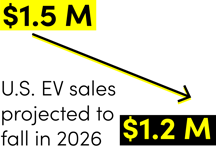
Moreover, IEA figures show that EV sales in the U.S. are projected to fall from 1.5 million to 1.2 million in 2026. At first glance, the slowdown appears counterintuitive. With gasoline prices up 50% since the start of the Iran war, and averaging $4.50 per gallon, this market cooling doesn’t initially seem to make sense. EV sales are slowing not only due to the cancellation of federal tax incentives but also due to high vehicle costs and the phenomenon of “battery range anxiety,” stemming from concerns of charging availability and infrastructure.
The implications extend well beyond climate policy. Retreating from one of the world's fastest-growing industrial sectors carries significant economic consequences. “Even though the U.S. launched the first modern electric car, Tesla's Model S, in 2012, it has lost all its competitive ground in both manufacturing and innovation. A shrinking domestic market is unlikely to help".
Without a change in policy direction, the U.S. risks ceding further manufacturing capacity, investment and technical expertise to overseas competitors. Consider the further decline in the auto industry, American workers not benefiting from electric-vehicle and sector-related upskilling, and the loss of hundreds of thousands of manufacturing jobs. As the inevitability of the historic electric transition becomes clear, the U.S. could ultimately be forced to import EVs, most likely from China, in a deeply ironic geopolitical and environmental twist.
The EV transition will not wait for the next U.S. President
Support them or oppose them, EVs are here to stay. The ongoing fossil fuel crisis is reshaping the global car market in the long term, while falling costs, improved technology, including battery ranges, and tighter emissions standards continue to accelerate adoption across much of the world. China's manufacturing dominance shows little sign of weakening, while Europe is expanding its EV market and emerging economies are increasingly establishing their own footholds.
For the U.S., the challenge extends far beyond climate policy or support for big oil. At stake are industrial competitiveness, technological leadership and manufacturing capacity. The global EV transition is already underway to varying degrees, but who will benefit most?
Re-entering the EV race will require the U.S. to have a long-term strategy focused on affordability and cost parity, infrastructure reliability and domestic supply chains. As the rest of the world zooms ahead, America's window to shape the next phase of EV sector growth is quickly narrowing.
Want more climate & sustainability insights? Check out these resources