
Mar 18, 2026 / By Sam Burritt
8 min read
SHORT TAKE: AI agents are beginning to influence how consumers discover products, compare options and complete purchases. Loyalty technology providers now face a new question: How will brand preference survive when algorithms control discovery and the shopping experience?
The way we interact and transact with brands—retail, travel and consumer—is changing. It’s not happening gradually, either.
AI was still widely considered science fiction five years ago. Today, it’s embedded in everyday consumer behavior. McKinsey estimates that nearly half of consumers now use AI when searching online, while Bain & Company reports that 30% to 45% of U.S. consumers already use generative AI to research and compare products.
What started as AI-mediated discovery is quickly becoming execution. Agents are starting to compare options, assemble baskets and complete checkout all on their own.
Loyalty, as it has traditionally been designed, may not survive that transition.
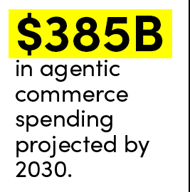 Morgan Stanley estimates that agentic commerce could generate $385 billion in spending by 2030. Bain estimates the potential U.S. market at $300 billion to $500 billion by the end of the decade. Again, this isn’t science fiction; these projections fall within the planning horizon for technology decisions being made today.
For loyalty technology companies, how they position themselves and their solutions ahead of this shift, when every provider is jumping on the agentic commerce bandwagon, will be the difference between survival and irrelevance.
Agentic commerce and the consumer-brand relationship
Agentic commerce may represent the next step in how consumers shop, on par with the rise of ecommerce. Rather than browsing websites and clicking "buy," consumers delegate tasks to AI agents. A consumer might tell an agent to find a replacement appliance part that arrives within three days at the best price, and the agent handles product matching, pricing comparisons and checkout.
Many retailers are scrambling to position themselves at the forefront of this shift. Walmart and Sam's Club went live on Google Gemini in January 2026, and Instacart became the first grocery partner for ChatGPT Instant Checkout in December 2025.
But even as retailers rush to master the transactional elements of agentic commerce, challenging questions about brand recognition are being raised. Like, “What will happen to my brand’s recognition within this environment?”
Decades of investment in SEO, paid traffic and brand building were meant to capture attention at the moment of discovery. When an AI agent is doing the discovering, those investments may no longer operate in the same way or generate returns. An agent optimizing for stated preferences such as price ceilings, delivery requirements or product specifications has no inherent concept of brand affinity.
And yet brand preference may not disappear entirely. Consumers still set the parameters. A shopper who specifies "my usual brand" or “my favorite retailer” in their shopping prompt reintroduces human preference into the agent's decision process.
Can loyalty programs remain present enough in consumers' minds to influence those preferences when the moment of purchase is no longer directly visible?
Can loyalty programs remain effective behavioral levers?
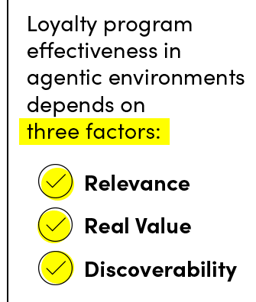 The effectiveness of loyalty programs in an agentic environment hinges on three factors: relevance, real value and discoverability.
Relevance means rewards and incentives must align with what consumers want. For example, 71% of consumers expect personalized experiences, and companies that excel at personalization generate 40% more revenue than average performers.
Generic points-based rewards are losing ground to more flexible options, such as discounts on preferred products, experiences that align with lifestyle choices and instant redemption via digital wallets.
Real value is the second requirement. Ninety percent of consumers are willing to switch brands for better rewards, and 78% would engage more if "pay with points" options were available, according to research from The Wise Marketer and Engage People. Rewards that feel abstract or difficult to redeem will not withstand competition from programs that deliver immediate, tangible benefits.
Discoverability is where the challenge becomes more technical and complicated. For a loyalty program to influence an agent's recommendations, the agent needs access to structured data, including machine-readable product feeds, real-time pricing, accurate inventory and explicit loyalty information like status or reward tier. This is something our partners at Eagle Eye have been focusing on recently, as discoverability will likely be the hinge point for many loyalty strategies in the agentic age.
Programs that exist only in human-readable formats will effectively be invisible to the new intermediaries.
SAP's Balaji Balasubramanian captured the dynamic in a 2025 article: "Creating customer loyalty in the age of agentic commerce means conquering two fronts: optimizing for discoverability and creating loyalty post-purchase."
The first front is technical, making catalogs agent-ready. The second is experiential, ensuring that on-time delivery and personalized rewards reinforce the relationship after the AI has done its job.
Technological solutions to technology problems
This suggests that program design alone will not address what is coming, and that’s a challenge that loyalty technology providers need to solve for today.
Design remains essential, as the underlying value proposition and member experience still determine whether a program is worth participating in. But how and when to expose data to maximize discoverability will become equally important. Agents favor retailers and loyalty programs that make buying straightforward.
To influence agent-driven purchasing decisions, loyalty platforms will need to make key data accessible in structured, machine-readable formats. That includes:
-
Product information and loyalty status data that conforms to agentic protocols, such as Google’s Universal Commerce Protocol (UCP), enabling agents to parse it directly.
-
Real-time data feeds that include loyalty benefits and redemption options, enabling agents to factor rewards into purchase decisions.
 The shift toward AI-mediated discovery is already visible. Adobe reported that AI-driven traffic to U.S. retail sites surged 4,700% year-over-year by mid-2025. Modern Retail estimates that daily shopping-related queries on ChatGPT have reached around 50 million. Most are still informational rather than transactional, but the volume of commerce-oriented intent flowing through conversational interfaces is already commercially significant.
The infrastructure enabling those transactions needs to be in place before the volume arrives.
Differentiation in a shifting landscape
The question loyalty technology providers should be asking themselves is: On which capabilities should we stake our position?
Some will differentiate on the ability to structure client data for agent consumption and surface loyalty information at the moment agents are making decisions.
Others will focus on AI-native program design, building reward frameworks that anticipate agent behavior and integrating with emerging commerce protocols such as Google's UCP and OpenAI's Agentic Commerce Protocol.
Still others may emphasize post-purchase engagement.
With discovery augmented by AI agents, humans maintain their loyalty based on what happens after the transaction. Personalized rewards and non-transactional loyalty interactions may become the new battleground for brand equity.
But the market has not yet caught up to these questions, and so the challenge is that most buyers do not yet know to ask for these capabilities.
They are evaluating loyalty platforms based on their current needs and their perception of the business results that loyalty technology can deliver. The platforms that can articulate why tomorrow's criteria are different will win the contracts being negotiated today.
How to win partners and influence contracting decisions
Just as with consumer decision-making, brand awareness matters. Having the right technology stack is necessary but not sufficient; buyers must be able to identify it.
Beyond product development, effective B2B marketing becomes essential.
Loyalty technology companies need to own the thought-leadership space by producing content that helps potential clients anticipate the challenges they will face before they arise. They need to go to market with clear propositions about how their solutions address agentic commerce as a present reality, among other problem-solution narratives.
Of course, visibility is the cornerstone of brand awareness.
Being present at industry events, contributing to trade publications and building relationships with analysts all help boost visibility and shape perception. When a brand's marketing leadership starts asking about agentic commerce readiness, the loyalty technology companies already talking about it will be the ones deeply embedded in the conversation.
Defining the conversation rather than reacting to it will separate stuffed sales pipelines from starving ones, and RFP winners from the runners-up.
The challenge now is not simply building the right capabilities, but explaining why those capabilities matter before the market fully understands the shift. That requires clear messaging, a credible industry perspective, and a go-to-market strategy that anticipates how agentic commerce will reshape buyer expectations.