

Mar 23, 2026 / By Melissa McClements
7 min read
SHORT TAKE: Is artificial intelligence (AI) an essential tool for making our world more sustainable or a net-zero threat? At present, it has the potential to be both. As the AI revolution gathers momentum, business leaders deploying the technology to strengthen corporate sustainability strategies must weigh the benefits against the environmental costs.
Where AI can help companies reduce environmental impact
AI’s advocates argue that it could accelerate the large-scale socio-economic changes needed to address climate change and environmental degradation. The World Economic Forum, for example, suggests that AI could speed the adoption of three key low-carbon technologies: solar and wind energy, plant-based proteins and electric vehicles. Together, these could reduce annual greenhouse gas emissions from the power, food and mobility sectors by up to six gigatons by 2035, roughly a 10% reduction in global emissions.

AI’s value lies in its ability to gather, measure and analyze vast amounts of data. In climate and environmental monitoring, AI can detect patterns in historical data to predict future outcomes with far greater accuracy than before, enabling businesses to make more informed decisions on how to reduce their environmental impact.
Likewise, AI-generated insights can identify operational issues that need urgent attention, from greenhouse gas emissions and water usage, to waste management, pollution and impacts on biodiversity.
Companies can benefit from AI-driven ESG platforms to collect, streamline and analyze sustainability data. After all, firms can only reduce their impacts on climate and nature once they have measured and located them. AI is especially useful when addressing Scope 3 emissions, the supply chain emissions that are notoriously difficult to quantify and reduce.
Across supply chains, AI can support sustainability in several practical ways:
-
Logistics optimization: AI can analyze transport networks to improve distribution routes, reducing fuel use and emissions.
-
Demand forecasting: More accurate demand predictions help companies avoid overproduction, cutting material waste and excess inventory.
-
Energy management: Aligning production more closely with demand reduces the energy used to manufacture unsold goods.
-
Linking sustainability to financial performance: AI can integrate sustainability data with financial metrics, helping companies evaluate environmental performance alongside costs and revenue.
-
Supplier assessment: AI can analyze supplier data to evaluate environmental and social practices across global supply chains.
-
Risk forecasting: AI can identify weather patterns and environmental risks that may disrupt manufacturing, distribution or sales.
The environmental trade-offs of AI expansion
For all its potential benefits, AI also presents three environmental challenges: a rapidly expanding carbon footprint, rising water consumption and increasing electronic waste.
Despite the perception that digital technologies exist in “the cloud,” they require vast amounts of physical infrastructure, including servers, data storage systems and cooling equipment. As AI becomes embedded in more aspects of daily life, technology companies are building more data centers to house this infrastructure, increasing demand for energy, land, and water.
According to the International Energy Agency, data centers accounted for 1.5% of global electricity consumption in 2024, a figure expected to double by 2030. With roughly 60% of the world’s electricity still generated by fossil fuels and AI still in the early stages of its trajectory adoption, ensuring that its growth does not undermine efforts to reach net-zero emissions by 2050 will be essential. A recent estimate suggests that AI-related activity produced as much carbon dioxide in 2025 as the entire city of New York.
 AI is also expected to significantly increase global water use, rising from 1.1B to 6.6B cubic meters by 2027. Datacenters require vast quantities of water to cool the servers that train and run large language models, while the electricity powering those systems is also water-intensive. With nearly two-thirds of the global population already experiencing severe water scarcity for at least one month each year, the scale of water required to sustain AI infrastructure raises difficult questions.
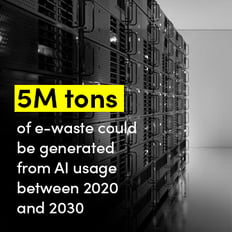
Moreover, AI relies on large server fleets that are replaced every few years, creating a rapidly growing stream of electronic waste. Research from the Chinese Academy of Sciences estimates that AI could generate 5 million tons of e-waste between 2020 and 2030. Much of this hardware contains valuable materials, including copper, gold, silver, aluminum and rare earth elements, raising questions about how datacenter operators will recover and reuse them.
Managing AI’s environmental footprint
Through climate modeling, sustainability data management and supply chain optimization, AI can significantly strengthen corporate ESG efforts. But business leaders cannot ignore the environmental cost of the technology itself.
The most credible approach is to acknowledge these impacts and take steps to reduce them. That includes greater transparency about AI’s energy and water consumption within sustainability reporting and targets, alongside partnerships with digital providers working on practical solutions, for example, aligning datacenter energy use with local, low-carbon energy sources.
Ultimately, AI’s rapid expansion will need to coincide with a much faster transition to renewable energy, while the companies developing and operating these systems develop more efficient ways to run them. Only then can organizations capture AI’s environmental benefits without expanding its footprint.
 To explore how sustainability expectations are changing across industries, download our report Disruption, Doubt and a New Direction.