
Dec 15, 2025 / By Sam Burritt
14 min read
Two of the world’s most developed retail economies, the United States and the United Kingdom, face a shared set of pressures moving into 2026: stubborn inflation, cautious consumers and persistent uncertainty.
These macroeconomic conditions are broadly similar across the two nations, but each market exhibits significantly different structural realities. Understanding both is essential for anyone trying to predict where global retail goes next.
Americans keep spending
The American market remains the world's largest consumer economy. Retail executives surveyed by Deloitte in early 2025 expressed cautious optimism for growth, and the numbers largely bore this out. Real GDP rose 2.8% in 2024 and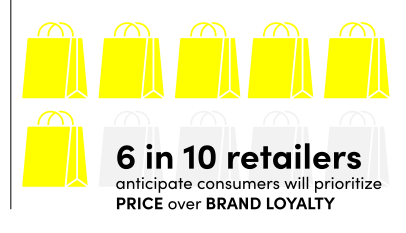 increased by 3.8% in the third quarter of 2025. Consumers are finally seeing moderate relief from inflation, a resilient labor market and falling borrowing costs as the Federal Reserve continues to cut rates. Yet in retail, value-seeking behavior dominates. Nearly six in ten U.S. retail executives in Deloitte's report anticipated consumers would prioritize price over brand loyalty, and we feel that’s unlikely to change heading into 2026.
Meanwhile, across the pond
The U.K. presents a more defensive position. According to PwC, household savings are higher than before the pandemic, and real incomes have risen for two consecutive years. But if the money is there, consumers’ confidence to spend certainly isn’t. Sticky inflation, elevated interest rates and the lingering shadow of cost-of-living pressures have pushed British shoppers toward a permanent value mindset. The Chancellor's Autumn Budget provided some relief through business rate reforms, but rising wage costs and new surtaxes on larger premises add another layer of complexity. Growth will be hard-won.
How do we forecast the 2026 retail outlook in these two linked yet dissimilar markets? Let’s take a comparative approach.
Reckoning with the value calculation
American consumers have developed what analysts call a "barbell" shopping pattern: heavy migration toward discount formats, off-price retailers and private label at one end, with selective spending on premium, luxury experiences and products at the other. Deloitte’s 2025 outlook notes that shoppers across income groups are switching to more affordable (and, in many cases, private label) brands, holding off on purchases until promotional periods, and making more frequent trips with smaller basket sizes. Grocery prices remain roughly 20% higher than four years ago, and that memory has reshaped shoppers’ habits in lasting ways.
British consumers have gone further. Discounters, including Aldi and Lidl, now command a combined 19.2% market share, their highest ever. Aldi alone reached a record 11.1% in May 2025, while Lidl hit 8.1%, attracting 419,000 more shoppers than the prior year, more than any other U.K. retailer.
Private-label sales exceeded branded product sales in the U.K. grocery sector in late 2023, and that trend shows no sign of reversing. According to Numerator research, Gen Z is projected to allocate 18.4% of their consumer goods spending to private labels by mid-2026, surpassing all other generations.
For U.K. retailers, the mandate is to compete on value or watch their customers walk away. For American retailers, the calculus is slightly more forgiving, but only slightly. “Value” will be the watchword of the new year in retail... once again.
Where shopping occurs: Delivery vs. pickup
The physical retail footprint looks dramatically different on either side of the Atlantic. The United States remains a car-centric market dominated by suburban big-box stores, warehouse clubs and outlet formats. Despite persistent headlines about store closures, 80% of all shopping still happens in physical locations, and shopping center vacancy sits at 5.4%, its lowest point in two decades. As of 2025, nearly half of U.S. retail executives plan moderate-to-significant investments in store remodels or new locations, with implementation continuing through 2026.
The U.K. operates a much denser, transit-served network in which national grocers and discounters play an outsized role. High streets and retail parks face persistent pressure to justify their footprints, and retailers are responding by repurposing space with click-and-collect points, services and experiential formats designed to drive longer visits. PwC notes that bricks-and-mortar remains central to brand experience and customer acquisition, but fluctuating footfall is putting pressure on store economics.
The question is not whether physical retail survives, but what it becomes.
The fulfillment arms race
Omnichannel retail (and, as one of our partners, Eagle Eye, asserts, Unified Commerce) is a dominant force in both the U.K. and America, but the execution differs sharply. In the U.S., buy-online-pickup-in-store (BOPIS) retail sales are projected to exceed $131 billion in 2026, growing approximately 10% annually. Walmart, for example, has announced plans to open five next-generation fulfillment centers of roughly one million square feet each, intending to provide 75% of the U.S. population with access to next-day or two-day shipping by 2026. Combined with ever-present delivery options and “dark store” serving third-party retail platforms, the fulfillment smorgasbord becomes almost overwhelming.
On the other hand, British retailers lean more heavily on click-and-collect and scheduled grocery delivery slots, leveraging their dense store networks to keep last-mile costs manageable. The U.K.'s smaller geographic footprint makes this approach economically sensible; the U.S. must spend more to cover greater distances.
But both markets share a common pressure: omnichannel customers spend 1.5 times more per month than single-channel buyers, according to research from Grocery Doppio and Incisiv. Yet the services they demand—BOPIS, curbside pickup, same-day delivery, flexible returns—are expensive to execute. Retailers that fail to crack the profitability equation will find themselves indefinitely subsidizing convenience.
Data and AI as the new margin
The most consequential divergence between the U.S. and U.K. may be how each market monetizes data and deploys artificial intelligence. American retail media networks have matured faster, anchored by Amazon, Walmart and Target, with projections suggesting retail media will account for a quarter of all US advertising spend by 2028, according to Dunnhumby.
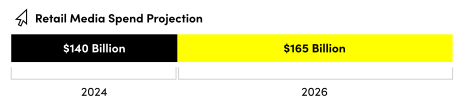
This boom is reflected globally, with retail media reaching about $140 billion in 2024 and projected to grow to $165 billion by 2026. U.S. retailers are at the forefront, experimenting aggressively with off-site networks, closed-loop attribution and generative AI for customer experience
U.K. retailers are also rapidly building their own media offerings, with Tesco's media business recently competing directly with major networks at the Media Week Awards… and winning. British grocers are monetizing loyalty data platforms and using AI to protect razor-thin margins by improving demand planning and labor productivity. Deloitte reported that retailers offering AI tools during the 2024 Black Friday weekend saw a 15% higher conversion rate; the numbers aren’t in yet for this season, but they are likely to reflect similar success.
The promise of AI extends beyond marketing. According to research cited by Forbes, 40% of companies use AI to optimize inventory. These systems analyze historical patterns, seasonal trends and external signals to ensure the right products arrive at the right locations. For retailers operating on thin margins, which is to say, most of them, this capability will separate survivors from casualties.
What comes next?
Both markets face a shared reality: growth will come from gaining share rather than riding market expansion.
The U.S. has scale and consumer spending power in its favor, but tariff uncertainty and trade tensions introduce volatility that could derail even the best-laid plans. A sharp, no-warning hike on tariffs (always a distinct possibility) could trigger broader economic contraction and force the Federal Reserve to raise rates in 2026.
 READ: Tariff Terror Tamed
The U.K. has fewer geopolitical wildcards but more structural constraints. Rising labor costs, reformed business rates and a consumer base conditioned to hunt for value will test every retailer's ability to protect margins while delivering experiences worth leaving the house for.
Neither market can afford complacency.
But the retailers who master AI-driven personalization, rationalize their fulfillment economics and monetize their data assets will own the next year and the decade.
Everyone else? Consolidating or closing could be the most likely outcomes in this challenging retail environment.
And with that, bring on 2026. Surprises included, as always.
 For companies supporting retailers in the U.S. and U.K., effective communication may be one of the few controllable advantages in 2026. Talk with us about how these dynamics affect your market position or if you’re re-thinking how your proposition will land in what looks to be another challenging year.